Every year, European municipalities spend billions excavating streets to replace pipes that could have been rehabilitated in place. The jackhammer has been the default answer for a century. But for the past two decades, a quieter, more precise technology has been steadily replacing it — one pipe at a time. Epoxy pipe relining doesn't just extend the life of a deteriorating pipe. It transforms it from the inside out, without touching a single cobblestone above.
This guide explains exactly how it works — the chemistry, the process, the equipment, and the decisions that separate a professional result from an expensive failure.
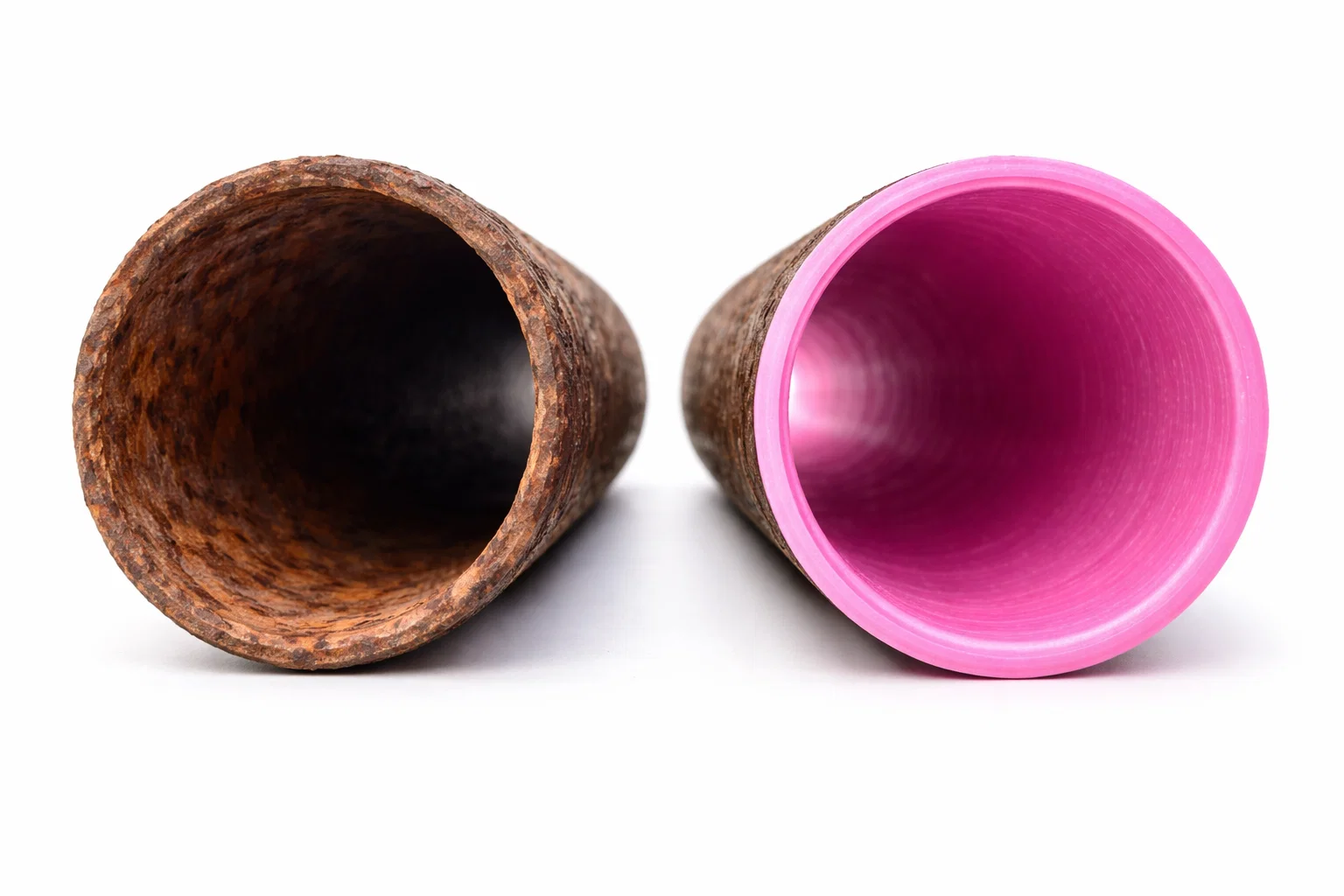
What Is Epoxy Pipe Relining?
Epoxy pipe relining — also called internal pipe coating or spray lining — is a trenchless rehabilitation method that creates a new protective surface inside an existing pipe using a chemically bonded epoxy resin layer. The pipe is cleaned, prepared, and coated from the inside — restoring structural integrity, sealing leaks, eliminating corrosion, and recovering flow capacity — without excavation.
Unlike traditional pipe replacement (remove and reinstall) or CIPP (cured-in-place pipe) lining where a resin-saturated liner is inverted into the pipe, epoxy relining works by applying a precisely controlled layer of resin directly to the interior wall. No liner. No curing bladder. No dig.
Where epoxy relining is the right answer
- Drain pipes and sewer pipes in residential and commercial buildings (DN32–DN150)
- Municipal infrastructure with structural cracks, root intrusion, or corrosion
- Industrial pipelines subject to chemical attack or abrasion
- Pipelines in historically sensitive areas where excavation is prohibited or impractical
The Chemistry: Why Epoxy Works Inside a Pipe
Epoxy is a two-component thermosetting polymer. When the resin (Part A) is combined with the hardener (Part B), a chemical cross-linking reaction begins — building a rigid, dense polymer matrix that bonds to the substrate at a molecular level. This is not paint. It does not peel. It does not soften. Once cured, epoxy achieves properties that make it uniquely suited to pipe rehabilitation:
- Compressive strength: Typically 70–85 MPa — stronger than most concrete mixes
- Chemical resistance: Resistant to acids, alkalis, and solvents common in sewage and industrial waste streams
- Substrate adhesion: Bonds to concrete, clay, cast iron, PVC, steel, and ductile iron — provided the surface is clean and dry
- Thermal stability: -40°C to +120°C depending on formulation
The key word in all of the above is clean. Epoxy does not bond to contamination. A poorly prepared pipe surface is the single most common cause of coating failure — not the material, not the equipment, not the contractor's skill. The surface.
This is why professional epoxy relining begins and ends with surface preparation, and why high-speed mechanical cleaning is not a preliminary step — it is the foundational step. The coating is only as good as the substrate it bonds to.
Brush Coating vs. Spray Lining (SIPP): Choosing the Right Method
Both methods apply epoxy to the interior pipe wall, but the mechanics, results, and optimal applications differ significantly. Understanding this distinction is critical before committing to equipment.
| Parameter | Brush Coating | Spray Lining (SIPP) |
|---|---|---|
| Application principle | Rotating brush distributes epoxy mechanically | Centrifugal force atomizes epoxy uniformly |
| Best for | Bends, junctions, irregular geometry | Straight runs, consistent diameter |
| Layer control | High — buildable, multiple passes | Very consistent — thin and uniform |
| Diameter range | DN32–DN150 (optimal) | DN100–DN300 (optimal) |
| Surface finish | Slightly textured — good flow restoration | Very smooth — maximum hydraulic efficiency |
| Speed | Moderate | High — suited to volume projects |
| Visual control | Camera mounted on the hose behind the nozzle — live feed during application | Camera mounted on the hose behind the spray head — live feed during application |
Most experienced contractors operate both systems — selecting the method based on site conditions, pipe geometry, and project scale rather than equipment availability. This is a direct consequence of how the industry has matured: a contractor locked into a single method loses jobs that don't fit that method. The professional standard is adaptability.

The Professional Process: Step by Step
Professional epoxy pipe rehabilitation follows a defined sequence. The steps are not interchangeable. Shortcuts in any phase do not save time — they move the failure forward.
CCTV Inspection
Before any work begins, a camera inspection documents the pipe's condition — diameter, material, defect type, location, and severity. This determines whether epoxy relining is the appropriate method. Complete pipe collapse, for example, requires a different approach. Inspection defines scope; scope defines cost; cost defines whether the project is viable.
High-Speed Mechanical Cleaning
The pipe must be free of grease, biofilm, scale, mineral deposits, and loose material before coating. High-speed machines — NoDig V1 or V8 — perform this preparation with chain flails and specialized heads matched to pipe diameter and deposit type. This step is not about getting the pipe "clean enough." It's about achieving a surface condition to which epoxy will bond at the required strength. The cleaning standard is a material specification, not a visual judgment.
Surface Drying
Moisture at the pipe wall is the second variable epoxy cannot tolerate. After cleaning, the pipe interior is dried to a specified relative humidity — typically below 75–80% at the surface, depending on the resin system. Compressed air is used for standard applications; heat guns for pipes in cold or damp environments. The drying time is not an estimation. It is measured.
Epoxy Application
Pre-mixed epoxy is introduced and distributed by the chosen method. In brush coating, the rotating head travels through the pipe depositing resin on each pass. In spray lining, the spinning spray head atomizes and centrifugally applies material at high RPM. In both cases, a camera is mounted on the hose directly behind the nozzle — providing a live view of coverage as it's applied, not verified after the fact. Three passes is the professional standard for a structurally complete, pinhole-free coating. Each pass must be applied within the resin's open time — the window during which the previous layer is still chemically reactive and the next layer will bond to it. Miss this window and the layers won't cross-link. They'll separate.
Curing and Final Verification
The coated pipe is isolated. Curing time varies by formulation and ambient temperature — typically 3–8 hours tack-free, 24 hours to full structural cure. A final camera inspection verifies uniform coverage, absence of voids or runs, and confirms thickness at representative points. The documentation from this inspection is the contractor's quality record — and the asset owner's proof of work.
Material Selection: Not All Epoxy Systems Are Equal
The performance of an epoxy pipe lining system depends on the material as much as the technique. Key parameters to evaluate when specifying a system:
| Parameter | What to look for |
|---|---|
| Viscosity | BSE is formulated at a single viscosity suited to both brush and spray application — no reformulation needed when switching methods |
| Pot life | Sufficient working time at typical site temperature, especially in summer conditions |
| Compressive strength (cured) | Minimum 60 MPa for structural relining applications |
| Elongation at break | Relevant for pipes subject to ground movement or thermal cycling |
| Chemical resistance certification | Match to effluent type — sewage, industrial wastewater, or aggressive chemicals |
One of the most underestimated risks in epoxy relining is the compatibility gap between equipment and material. A spray head calibrated for a 3,000 mPa·s resin will not perform correctly with a 6,000 mPa·s material. The atomization breaks down. Coverage becomes uneven. Adhesion suffers. This is not a failure of the resin or the machine in isolation — it's a system integration failure.
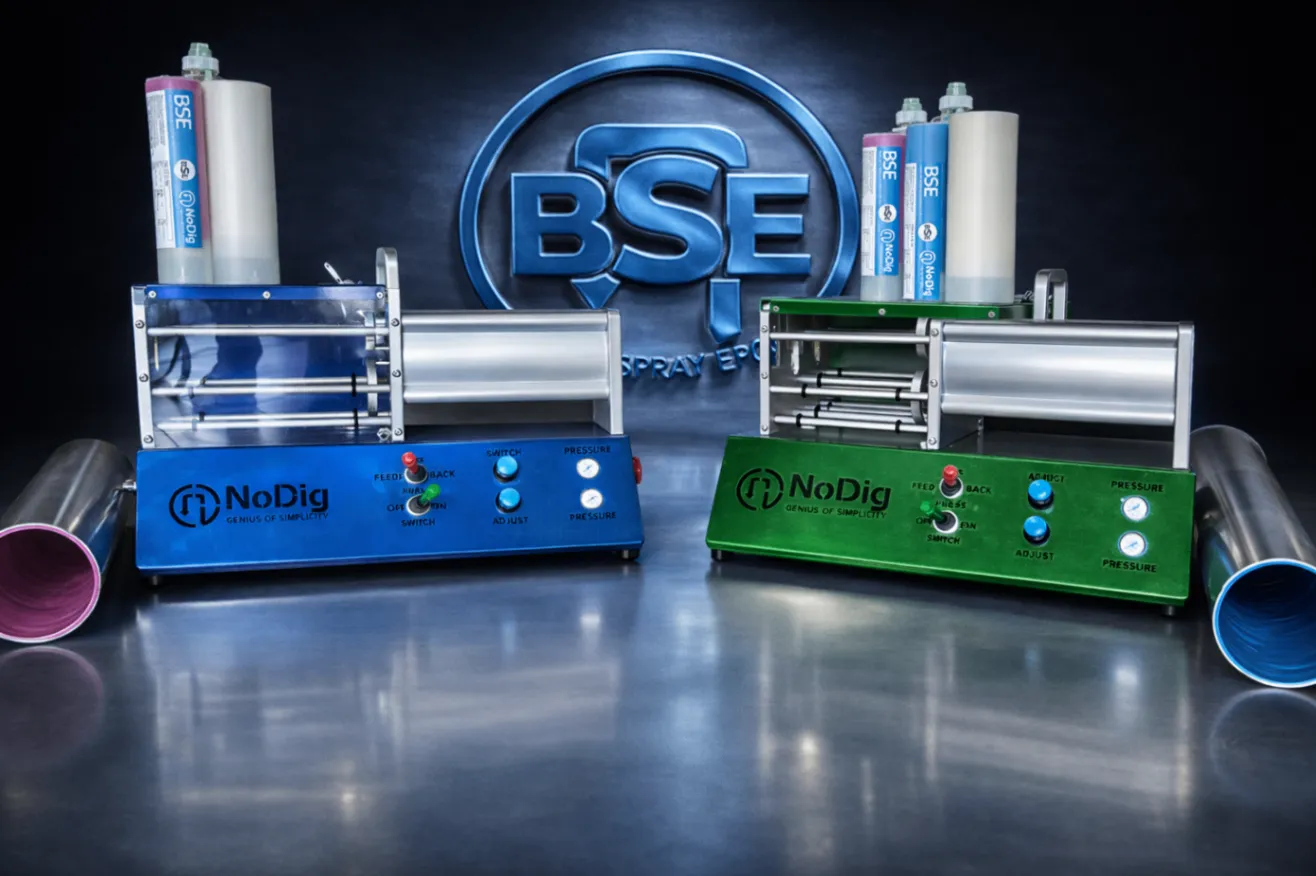
BSE Epoxy — The Material Designed for the Method
BSE (Brush and Spray Epoxy) is NoDig's purpose-formulated epoxy resin for internal pipe coating. This is not a generic construction epoxy applied to pipe rehabilitation — it is a material whose viscosity, pot life, and cure characteristics are developed specifically for pneumatic brush and spray application. The formulation is matched to the operating parameters of the ProLight and ProLight2 machines: brush head rotation speed, spray head geometry, and working temperature ranges that occur on real job sites.
This distinction matters. A resin optimised for a different application method — or a spray head calibrated for a different viscosity range — produces uneven coverage, inconsistent layer thickness, and adhesion that cannot be relied upon. BSE is formulated to eliminate that uncertainty.
BSE Epoxy — key properties
- Formulated for pneumatic brush coating and spray lining application
- Available for drain/sewer and industrial applications
- Two-component system — matched resin and hardener ratio
- Application parameters specified per formulation and ambient temperature
- Available through NoDig in 15+ European countries
BSE Epoxy by NoDig
Purpose-formulated for brush and spray application. Matched to ProLight and ProLight2 machines.
ProLight, ProLight2 & The Pipe Boy: The Machines Behind the Method
The ProLight is NoDig's purpose-built machine for epoxy coating applications. Fully pneumatic — no electrical connection required. This eliminates one of the most common practical constraints on rehabilitation projects inside buildings: power availability in confined utility corridors, underground shafts, and occupied residential properties.
The pneumatic design is not a cost reduction. It is a deliberate engineering choice that removes an entire category of field problems — ground fault protection, waterproofing compliance, electrical safety standards that vary by country, and the logistics of running power to inaccessible locations. A pneumatic fitting, if it fails on site, can be sourced and replaced anywhere in the world. A failed proprietary electrical controller cannot.
ProLight — key specifications
- Drive: Fully pneumatic — 6–8 bar compressed air
- Methods: Brush coating and spray lining — both from one machine
- Diameter range: DN32 to DN200 with appropriate head selection
- Power supply: Standard mobile compressor — no electrical infrastructure required
- Serviceability: Repairable with standard tools. No proprietary components.
The ProLight2 (Double Press) takes this further — a two-component system that processes both resin and hardener simultaneously through separate cartridges, ensuring consistent mix ratio on every pass. It is the preferred choice for contractors handling high volumes or working with fast-curing formulations where manual mixing introduces variability.
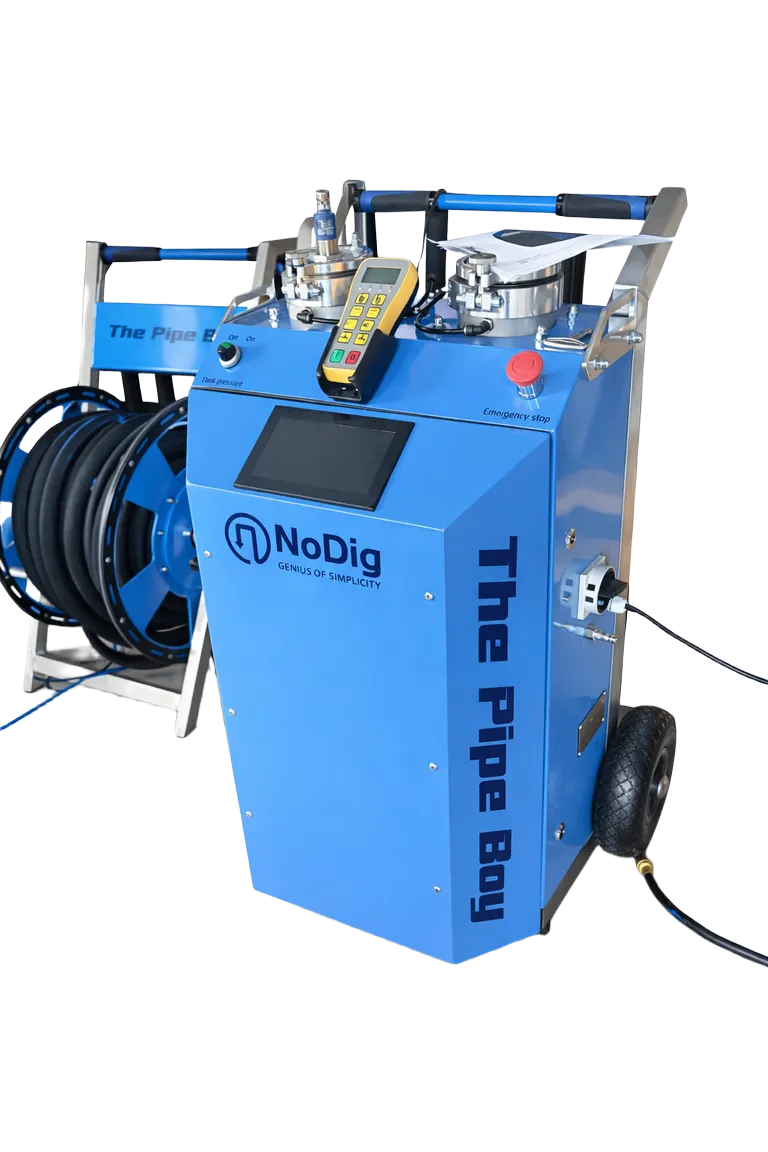
The Pipe Boy rounds out NoDig's coating machine range — handling both brush coating and spray lining (SIPP), optimised for larger-diameter pipes and long runs. Certified to DN300 and successfully tested on pipes of considerably larger diameters. Like ProLight and ProLight2, it runs on compressed air, requires no electrical connection, and is matched to BSE epoxy.
ProLight, ProLight2 & The Pipe Boy — Pneumatic Coating Machines
Brush and spray in one machine. ProLight2 Double Press for two-component epoxy. The Pipe Boy for brush coating and spray lining in larger diameters and long runs.
The Economic Case: Why Infrastructure Managers Are Moving This Way
The case for epoxy relining over excavation has been documented in infrastructure investment analyses across Europe. The numbers are consistent:
In urban environments — where open excavation requires traffic management, utility diversions, surface reinstatement, and public liability for the works period — the cost differential between dig and no-dig is often greater than 2:1 in favor of relining. In historic city centers or densely built residential areas, it is frequently the only permissible method.
The question infrastructure managers increasingly ask is not whether to use epoxy relining — but which system, and from whom. The technology is proven. The decision has become one of supplier selection.
Simplicity as an Engineering Philosophy
The most durable technologies tend to be the ones that are also the simplest to operate, maintain, and repair in the field. This principle runs through every product in the NoDig range — not simplicity as a constraint, but simplicity as a deliberate design target.
Epoxy pipe relining is not new technology. What continues to evolve is the equipment used to apply it — becoming more reliable, more adaptable, and more accessible to professional contractors who need systems that work on real job sites, not just in demonstration conditions. Contractors who cannot afford to wait six weeks for a spare part. Contractors who operate in three countries and need the same machine to comply in all three.
NoDig builds that equipment. In Osijek, Croatia. With full after-sales support across 15+ European countries. If you're evaluating systems for a rehabilitation project or looking to expand your service offer, we're a direct conversation — no distributor chain, no waiting.
Frequently Asked Questions
Epoxy pipe relining is a trenchless rehabilitation method that creates a new protective structural surface inside an existing pipe using a two-component epoxy resin — applied without excavation. The pipe is cleaned, dried, and coated from the inside, restoring structural integrity and sealing leaks with no ground disturbance.
A professionally applied epoxy pipe lining typically extends the service life of the host pipe by 25 to 50 years, depending on the resin system, the host pipe condition, and the type of effluent carried. Some certified systems are rated for over 50 years in sewer applications.
Epoxy coating systems are effective for diameters from DN32 to DN300. Small diameter drain pipes (DN32–DN150) are the most common application — particularly in residential buildings, hotels, and commercial premises. Larger municipal sewers (DN100–DN300) are typically rehabilitated with spray lining methods.
Brush coating uses a rotating brush on a flexible shaft to mechanically distribute epoxy — high control, ideal for pipes with bends and junctions. Spray lining (SIPP) uses centrifugal force at high rotation speed to atomize epoxy uniformly — faster, suited for straight runs and larger diameters. NoDig's ProLight machine handles both methods.
No. Epoxy pipe relining is a completely trenchless process. Inspection, cleaning, surface preparation, coating, and verification are all carried out through existing access points, without opening the ground above the pipe.
BSE (Brush and Spray Epoxy) is NoDig's purpose-formulated epoxy resin for internal pipe coating. Its viscosity, pot life, and cure characteristics are matched to the ProLight and ProLight2 pneumatic application machines — eliminating the compatibility problems that arise when equipment and materials are sourced independently. Available for drain/sewer and industrial applications.