The call comes in at nine on a Monday morning. A facilities manager for a housing association — a five-floor residential block in the city centre, around seventy residents. Ground floor drainage has been backing up for months, and in the past year it has reached the first-floor flats as well. The previous contractor was out in spring: "Jetted it through, said it was clear." But it isn't clear. Or more precisely: it is clear, but it isn't prepared. And those are two entirely different things.
Cleared ≠ clean ≠ prepared for lining
High-pressure jetting does exactly what it says on the tin — it mechanically breaks up and flushes out blockages. Grease, silt, loose deposits — all of it clears with sufficient bar pressure and the right nozzle configuration. That is legitimate, effective work, and in many situations it is all that is needed.
The problem arises when that logic — "it's clear, job done" — enters the context of pipe rehabilitation. Because epoxy lining compounds have no tolerance for compromise. They either bond to the substrate, or they do not — there is no halfway. Scale that has chemically fused with the pipe wall over years of hard water exposure, a corrosion layer that has been undermining the metal, biofilm embedded in the surface pores — none of this comes off with a jetter. The jetter flushes the surface clear, but what is genuinely adhered remains. And that is precisely where the problem starts.
We applied the epoxy. It looked perfect. Six weeks later, the client sent us photographs. The lining had started peeling away from the pipe wall — like wallpaper lifting in a damp bathroom. The cause was immediately clear: the substrate hadn't been properly prepared. Jetting wasn't enough. We redid the entire project at our own cost.
This is not a hypothetical scenario. It is the outcome that drainage contractors know well — those who have at least once skipped the mechanical cleaning step because they assumed high-pressure jetting was sufficient, because the schedule was tight, or because the client was reluctant to pay for "another line item." The cost of that shortcut is typically a multiple of the saving.
What actually happens inside the pipe
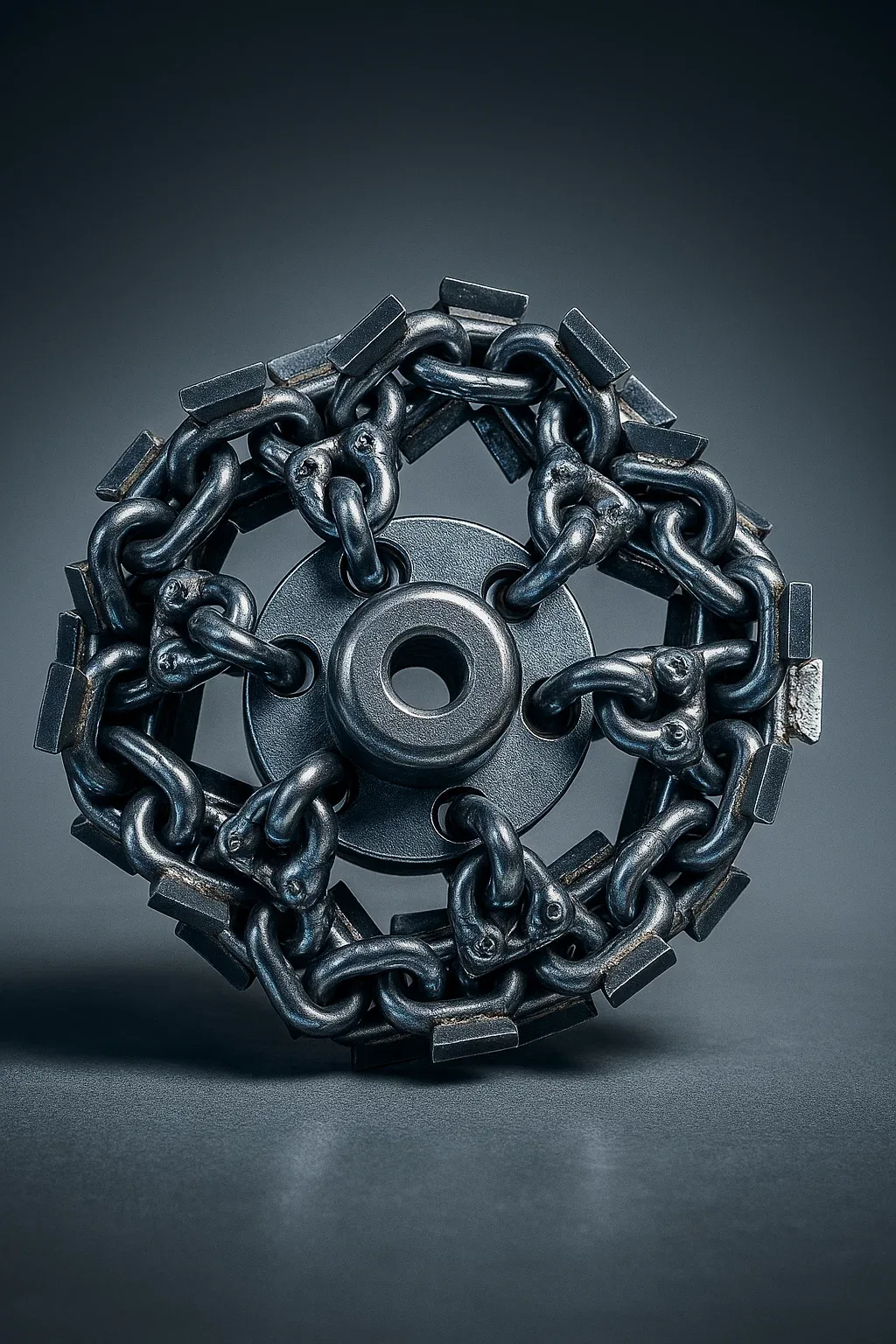
When a chain rotates at several hundred to two thousand RPM and contacts the pipe wall, this is not uncontrolled hammering. It is controlled abrasion. Each impact removes a micro-layer of deposit — scale, concrete, rust, failed coating. The process is not random; it is defined by the chain geometry, the number and configuration of the links, the rotational speed, and the impact energy. Change the chain type and you change what you remove.
The result is not simply "a cleaner pipe." The result is a roughened, reactive substrate — uniform, free of residual material, and without any smooth patches where the lining compound has nowhere to grip. That is what epoxy resin requires for a lasting bond: a surface profile measured in microns, but one that translates to decades of service life.
The difference in one sentence
Jetting clears a pipe so it flows. Chain cleaning prepares a pipe to hold — for twenty, thirty, fifty years.
Three machines, three scenarios
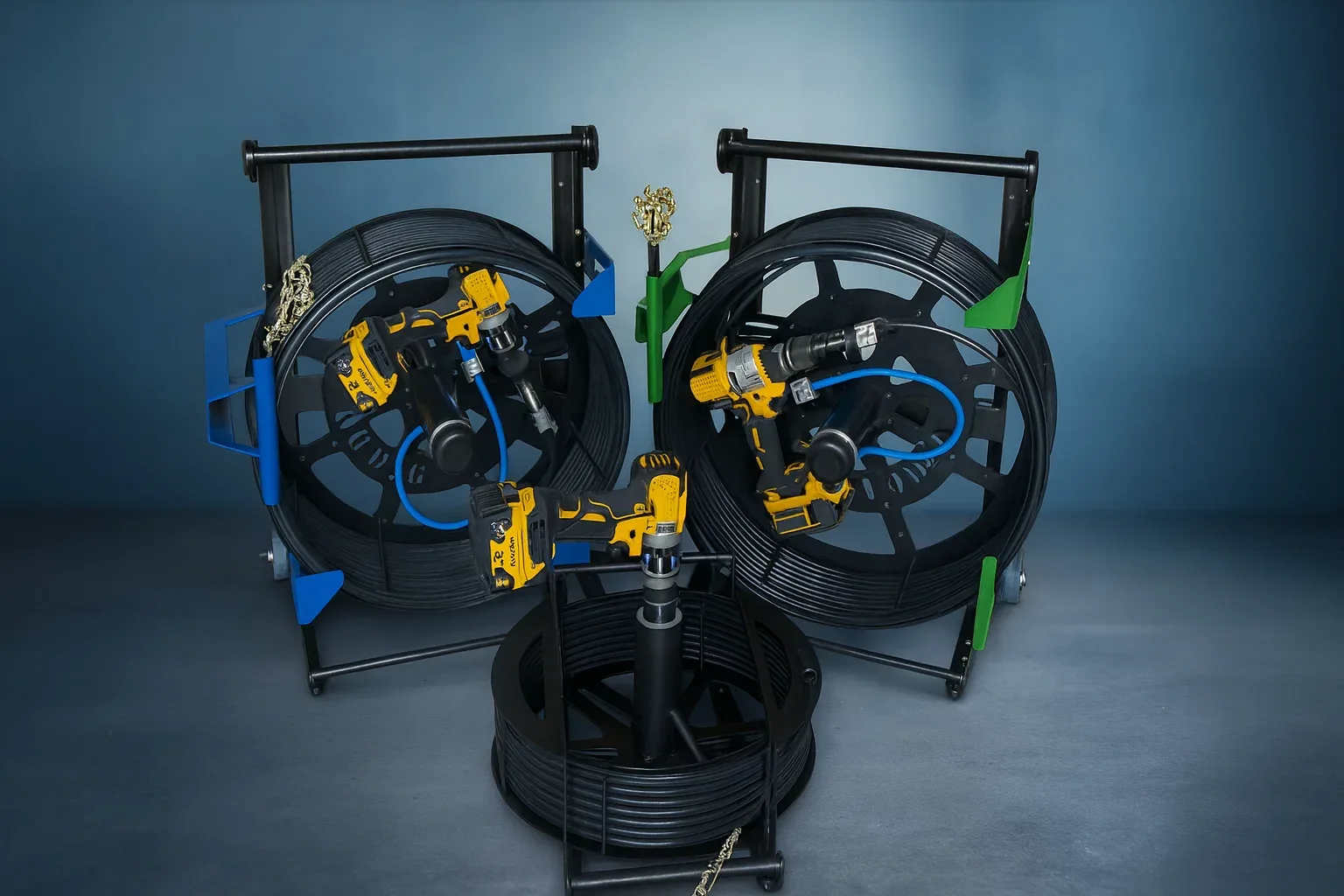
NoDig currently offers three machines in the range: V8, V1, and mini6. Each is engineered for a different operating context — the differences are not just about size but about the entire philosophy of deployment.
V8 — when the job demands serious power
The V8 is the machine you specify when you know what is waiting in the collector. Nominal bore DN50 to DN150, DeWALT 18V/54V battery, 8mm cable on an 18-metre drum. This is the tool for municipal drainage networks, industrial plant, and collectors that have not seen a cutter for years. Scale building up at a centimetre a year, corrosion that has turned the interior from metallic grey to deep rust — the V8 works through it methodically, pass by pass.
On site, experienced operators "listen" to the pipe through the V8: a change in sound pitch signals a change in material, an increase in resistance means you have hit a denser deposit. It is feedback from the pipe, not just noise from the machine.
V1 — the compact workhorse
The V1 is the machine drainage contractors tend to keep in the van permanently. Versatile, responsive, and built for rapid intervention — it covers DN32 to DN100 on a DeWALT 18V battery. It can be taken into a residential building without specialist access arrangements, gets up and running quickly, and performs equally well across residential, commercial, and light industrial drainage.
The V1 is purpose-built for jobs where the programme does not allow flexibility — one morning to prepare the section, the afternoon for the coating. In residential blocks with multiple stairwells and limited time on site, its ease of mobilisation and speed of setup represent a significant operational advantage.
mini6 — for everything small and confined
The mini6 is something of a specialist. The lightest machine in the range, it is driven by any standard cordless drill — the machine is supplied without a drill, which means it slots into the toolset you already carry. DN32 to DN100, designed for domestic pipework, internal drainage, and access points where the V8 physically cannot manoeuvre.
Its effectiveness consistently surprises contractors encountering it for the first time. Small, but the principle is identical: chains rotate, scale exits, the substrate becomes active. Contractors working on residential refurbishment carry the mini6 as standard kit, using the V1 or V8 when the specification calls for it.
Chains — selected, not grabbed at random
The machine is only one side of the equation. The other is chain selection — and this is where many contractors go wrong when starting out. There is a meaningful difference between a chain designed for limescale, one for grease, and one for corrosion. The difference is not cosmetic — different link geometry, different mass, different impact angle. The wrong chain for the deposit type means more passes, more time, and a worse result.
This is precisely why the CCTV survey comes before cleaning, not after. The camera tells you what is in the pipe — and on that basis you select the tool. Not all collectors are the same. Sometimes it is grease from a restaurant that has been layering up for years. Sometimes it is hard limescale from a high-hardness water supply. Sometimes it is rust, sometimes a failing cementitious lining. Each scenario requires a different approach.
A process that cannot take shortcuts
When the work is being done properly — whether the objective is cleaning alone or substrate preparation for rehabilitation — the process has an internal logic that holds itself together. There is no room for improvisation between steps, only for adaptation within them.
CCTV survey
The camera goes into the pipe and you document everything — nominal bore, pipe material, deposit type and location, joint condition, presence of cracks or deformation. This footage is the foundation for everything that follows. Without it, you are selecting tools based on assumptions — and assumptions are expensive.
Tool and chain selection
Based on the survey, you define what is in the pipe and which tool is appropriate. V8, V1, or mini6 — and which chain type. The cable must be the right length for the working section. This step takes ten minutes and saves an hour on site.
Mechanical chain cleaning
The machine enters the pipe, chains rotate. You work at a controlled feed rate — fast enough to maintain effective contact, slow enough to avoid overheating. The number of passes is dictated by the deposit thickness, not the clock on the wall. The standard is "the pipe is prepared," not "we have made three passes."
Post-clean verification survey
The camera goes back in. You are looking for a uniform, dry substrate free of residual material. If areas of deposit remain, you return with the tool. This is not a procedural formality — it is the only way to confirm the work is actually complete.
Handover to the next stage
Cleaning is complete. The pipe is returned to service — or, increasingly, handed over to the lining crew. The cleaning documentation forms part of the technical file for the whole project. Without it, you cannot demonstrate what you handed over.
Why combined cleaning and lining is a growing contract sector
More and more drainage contractors are recognising that drain cleaning is an entry point into a substantially larger market. Housing associations, local authorities, facilities management companies, and industrial operators are no longer just looking for someone to clear a blockage — they are looking for someone to address the infrastructure. For ten, twenty, thirty years.
That means the contractor who arrives with a V8 or V1 and a CCTV camera, carries out a condition survey, and can offer a complete package — chain cleaning, verification, epoxy coating with BSE compound through the ProLight or ProLight2 — is selling a project worth five times the drain cleaning call-out. With significantly less competition, because that combination of capabilities is not universally available.
The most valuable moment on site is not when the chains start turning. It is when the client asks: "Can it be protected so I don't have to call someone back in twelve months?" — and you can say yes.
NoDig's V8, V1, and mini6 machines — designed and manufactured by NoDig d.o.o. in Osijek — are built as part of that complete system. They are compatible with the rest of the NoDig ecosystem: the same access configurations, the same bore ranges. Contractors working with NoDig equipment on both cleaning and rehabilitation are not switching between systems — they are using the same technical language across the whole process.
V8, V1 and mini6 — direct from the manufacturer
Designed and built in Osijek. No intermediaries, with technical support across 15+ European countries.
On a common misconception
The line that comes up regularly: "Jetting is faster and cheaper — the client doesn't need to know the difference."
Perhaps. In the short term. But the client always finds out — just not immediately. They find out when the lining fails. When you are called back to redo the job. When they do not call you for the next contract — or, at the far end of the scale, when their solicitor does.
High-speed chain cleaning is not a more expensive version of the same job. It is a different job. A job with a different outcome, a different service life, and a different conversation with the client. And when you understand that distinction — and can explain it clearly — you sell differently. Better.
High-speed pipe cleaning — machine specifications and applications Epoxy pipe rehabilitation — what comes after cleaningFrequently asked questions
Jetting is highly effective at clearing blockages and flushing loose debris, but it cannot mechanically abrade scale and corrosion that is chemically bonded to the pipe wall. Epoxy lining compounds require a clean, roughened substrate to achieve adhesion. Without chain cleaning, the lining will delaminate and the project will need to be repeated from scratch.
The V8 (DN50–DN150) is designed for heavy industrial and municipal applications with a DeWALT 18V/54V battery. The V1 (DN32–DN100) is compact and suited to residential and commercial buildings, running on a DeWALT 18V battery. The mini6 (DN32–DN100) is the lightest machine in the range, driven by any cordless drill (not included), and designed for internal pipework and confined spaces.
The number of passes depends on the deposit type and thickness. For substrate preparation ahead of epoxy lining, the standard is not "until it looks clean" — it is until a post-clean CCTV survey confirms a dry, uniform surface free of residual material. Two to three passes is typical for moderately scaled pipes; heavily calcified or corroded pipes will require more.
With correct tool selection and appropriate feed rate — no. Chains and rotational speed are chosen to match the pipe bore and material. Softer chains with reduced impact energy are used on plastic or ceramic pipes. The pre-clean CCTV survey defines the pipe condition and informs the tool selection — the process is always led by the inspection data, not by the equipment.
After chain cleaning, a verification CCTV survey confirms the substrate quality. The pipe is dried before epoxy application — either brush coating or spray lining — using the ProLight or ProLight2 machine with NoDig's BSE epoxy compound. Cleaning and lining are inseparable steps in the same rehabilitation procedure; one cannot be done properly without the other.