Every year, municipalities, building managers and industrial operators spend far more than necessary — excavating, breaking and replacing pipes that could have been rehabilitated from the inside at a fraction of the cost, in a fraction of the time. Trenchless epoxy pipe lining is not a compromise. It is a precision method with documented results and a service life extension of 25 to 50 years — without a single shovel in the ground.
NoDig ProLight, ProLight2 and The Pipe Boy are designed for both application methods — brush coating and spray lining — with BSE epoxy resin developed specifically for this purpose. A complete system from one manufacturer, in Osijek, Croatia.
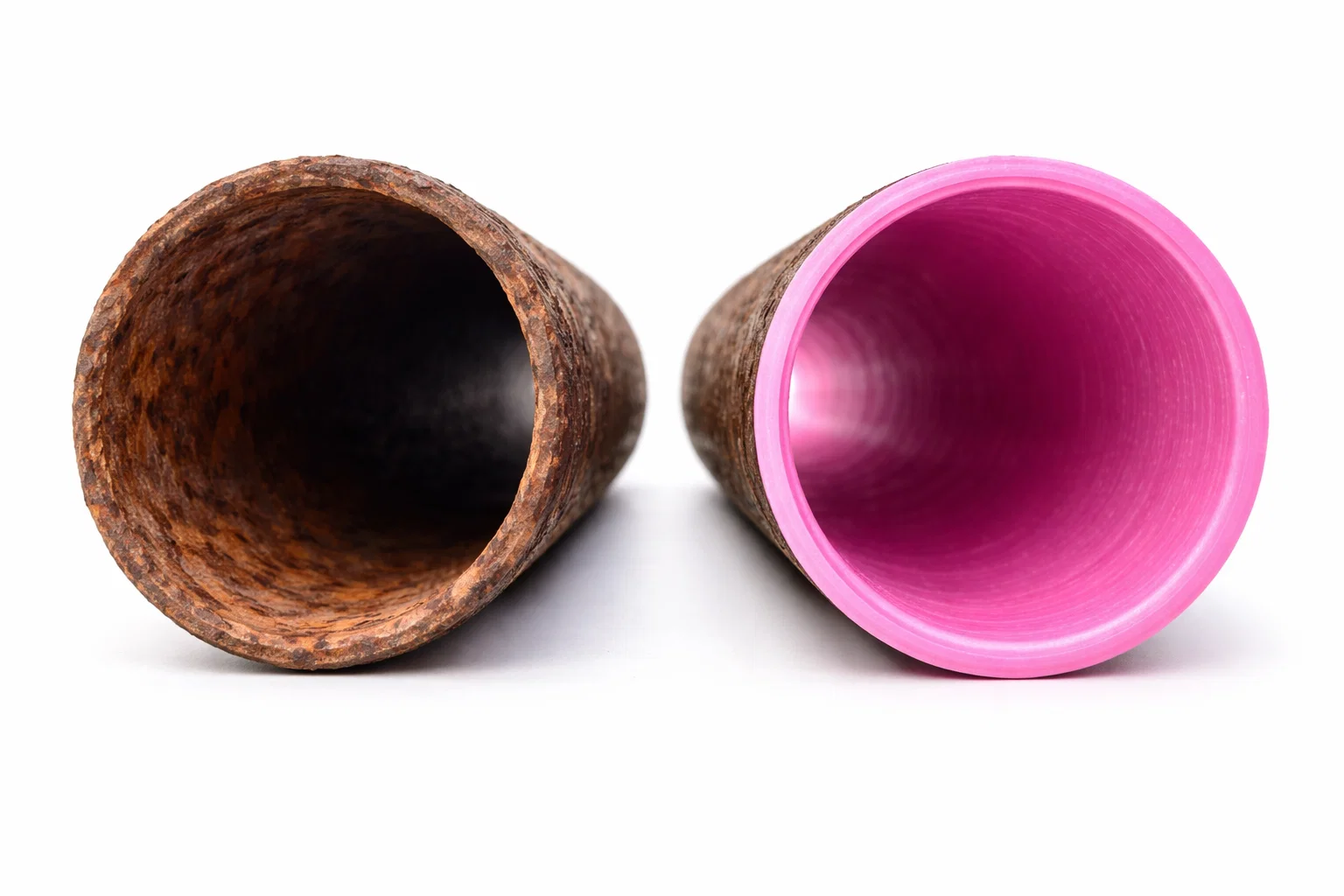
What is trenchless epoxy pipe lining?
Trenchless epoxy pipe lining — also known as internal pipe coating, pipe coating, spray lining or SIPP (Spray-in-Place Pipe) — is a no-dig rehabilitation method in which a two-component epoxy resin is applied to the interior pipe wall through existing access points. The pipe is cleaned, prepared and lined from the inside — without excavation, without pipe replacement, without breaking floors or walls.
Unlike pipe replacement (expensive, slow, invasive) or CIPP lining (pull-in-place liner under pressure), epoxy coating applies a precisely controlled resin layer directly onto the interior wall. No liner. No inflation. No digging. The result: a new protective surface that restores structural integrity, sealing and corrosion resistance.
When trenchless epoxy pipe lining is the right answer
- Drainage rehabilitation in residential and commercial buildings (DN32–DN150) — without demolition
- Municipal infrastructure with cracks, corrosion or root intrusion
- Industrial pipelines exposed to chemical attack or abrasion
- Protected and urban zones where excavation is prohibited or economically unviable
- Situations where minimising operational downtime is critical (hotels, hospitals, occupied buildings)
Why epoxy pipe lining — the numbers that matter
The question infrastructure managers increasingly ask is not whether to use epoxy lining — it's which system and from whom. The technology is proven. The decision has become a supplier selection.
Brush coating or spray lining — selecting the method
| Parameter | Brush Coating | Spray Lining (SIPP) |
|---|---|---|
| Application principle | Rotating brush mechanically spreads epoxy over the pipe wall | Centrifugal force sprays epoxy uniformly over the full circumference |
| Ideal for | Bends, junctions, irregular geometry, short sections | Straight runs with consistent diameter, higher volume projects |
| Layer control | High — multiple passes and localised correction possible | Even — thin, consistent layer in a single pass |
| Optimal diameters | DN32–DN150 | DN100–DN300 |
| Surface finish | Lightly textured | Smooth — maximum hydraulic efficiency |
| Speed | Moderate — precision is the priority | High — suited to projects with long pipe runs |
| Visual verification | Camera directly behind the brush — live view during application | Camera directly behind the spray head — live view during application |
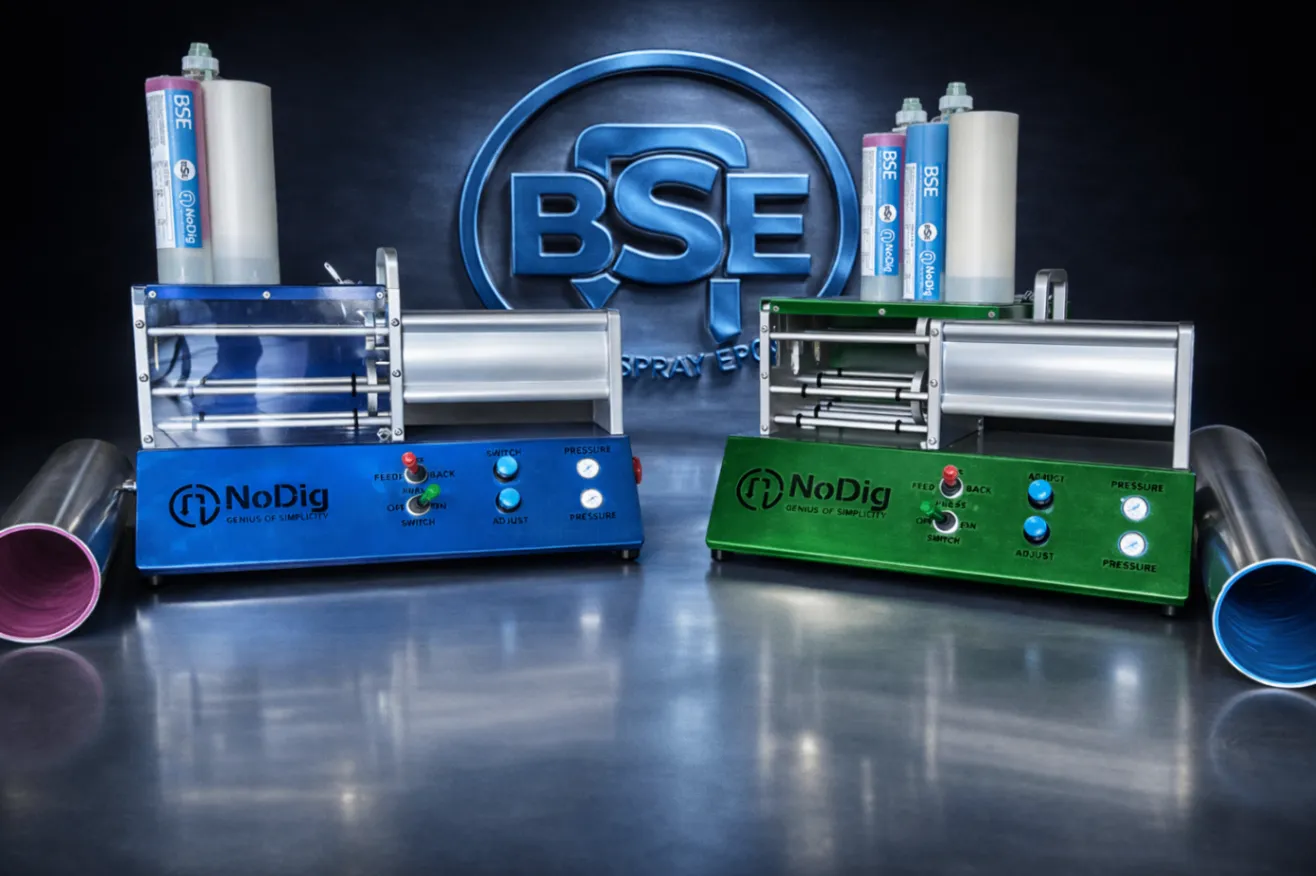
Experienced contractors use both methods and select by site conditions. ProLight covers DN32–DN125, ProLight2 DN40–DN150 — both support both methods from a single machine. For larger diameters (DN50–DN300) and long pipe runs, The Pipe Boy is used — an industrial machine with heated hoses, remote control and a flow rate of 370 g/min.
Professional rehabilitation process — step by step
CCTV camera inspection — define the condition
Camera inspection documents pipe condition — diameter, material, type and location of damage — and confirms whether epoxy coating is the appropriate method. The inspection defines the scope; the scope defines the cost and application method. No inspection means no informed decision.
High-speed mechanical chain cleaning
The pipe must be clean — free of grease, biofilm, scale and loose material. NoDig V1 or V8 perform this preparation with chain tools. This is not optional — epoxy does not adhere to contaminated surfaces. The cleaning standard is a material specification, not a visual judgement call.
Surface drying
Moisture on the pipe wall is the second variable epoxy does not tolerate. The interior is dried with compressed air or a heater to the specified relative humidity level. Not by estimate — by measurement.
Epoxy application
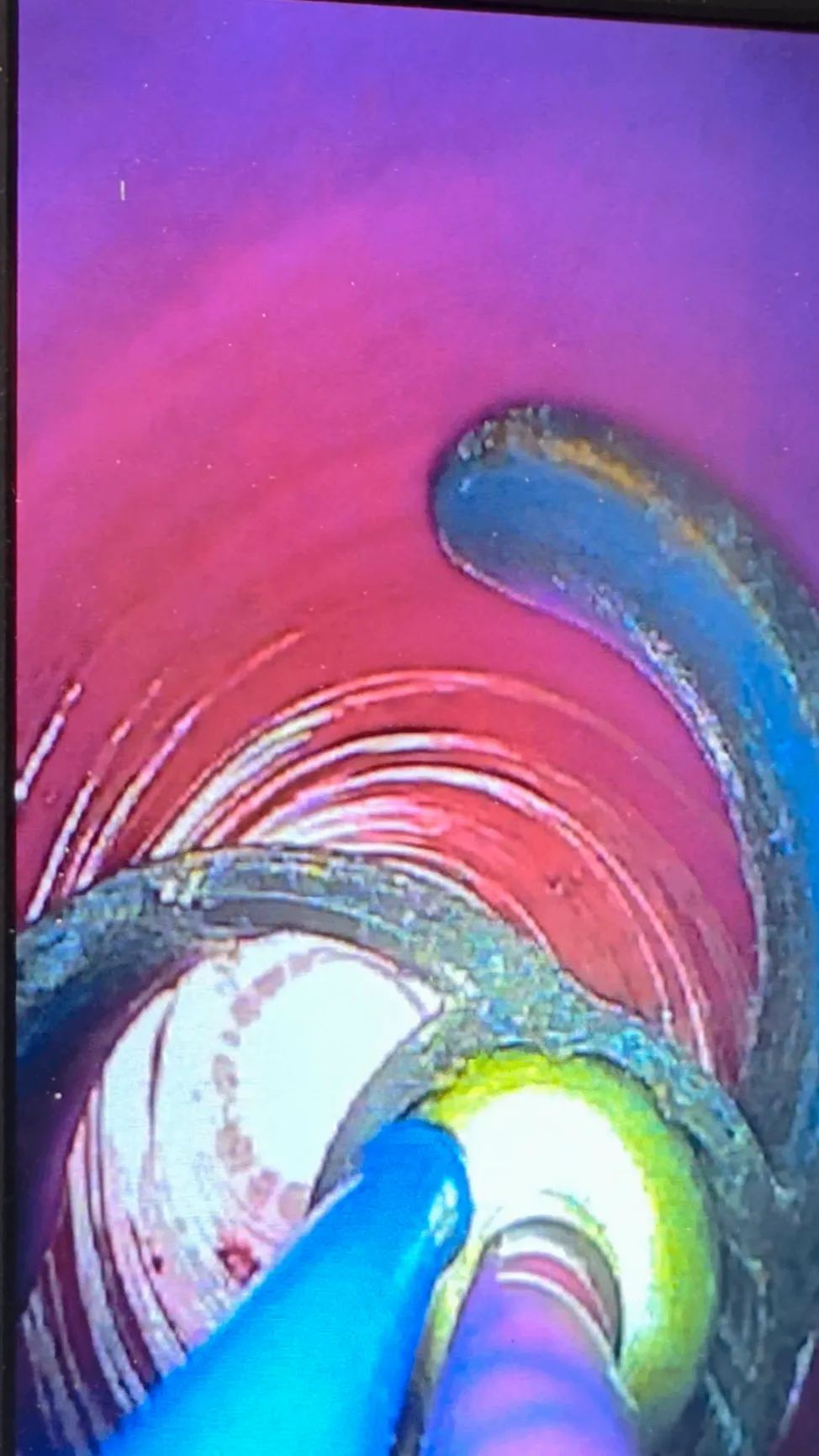
Pre-mixed BSE epoxy is applied using the selected method (brush or spray). In both cases the camera is mounted directly behind the nozzle, providing a live view of the application in real time. Three passes is the professional standard for a structurally sound lining. Each layer must be applied within the resin's open time window.
Cure and verification
The rehabilitated section is isolated for curing. Final camera inspection verifies coverage uniformity and confirms the absence of voids or bare spots. Documentation is the contractor's quality record — and the building owner's proof of work performed.
BSE epoxy — the material built for the method
BSE (Brush Spray Epoxy) is not a generic construction epoxy applied to pipe rehabilitation. It is NoDig's proprietary formulation — viscosity, open time and cure characteristics developed specifically for pneumatic brush and spray application:
- Formulated for pneumatic brush and spray application — the same resin for both methods
- Two-component system — precisely matched resin-to-hardener ratio
- Available for drainage and industrial applications
- Application parameters specified by formulation and ambient temperature
- Available through NoDig in 15+ European countries
ProLight, ProLight2, The Pipe Boy & BSE epoxy
ProLight for DN32–DN125, ProLight2 for DN40–DN150. The Pipe Boy for DN50–DN300 and industrial projects — heated hoses, remote control, 370 g/min. BSE epoxy compatible with all machines.
Complete system: machines + tools + materials
Epoxy pipe rehabilitation is not a single component — it is a system. The outcome depends on the alignment of all elements: machine, brushes or spray heads, hoses, epoxy resin (BSE) and inspection camera. NoDig offers every element of the system from a single source, optimised to work together.
- ProLight — brush coating and spray lining, DN32–DN125, pneumatic (6–8 bar)
- ProLight2 — Double Press, two-component epoxy, DN40–DN150
- The Pipe Boy — industrial brush and spray machine, DN50–DN300, heated hoses, 370 g/min, remote control
- All brush coating and spray lining machines — overview and comparison
- Pipe coating brushes — range by diameter and method
- Spray heads and centralisers — nozzles for uniform application
- Hoses for brush and spray — selection by run length and diameter
- Epoxy resins and materials — BSE and compatible materials
Frequently asked questions
Trenchless epoxy pipe lining is a no-dig rehabilitation method in which a two-component epoxy resin is applied to the interior pipe wall through existing access points — without excavation, without pipe replacement and without demolition. The pipe is cleaned, prepared and lined from the inside. The result is a new protective surface extending pipe service life by 25–50 years.
Brush coating uses rotating brushes to mechanically distribute epoxy over the pipe wall — ideal for bends, junctions and irregular geometry. Spray lining (SIPP) uses centrifugal force to spray epoxy uniformly over the full circumference — producing a smooth surface and high application speed on straight pipe runs. ProLight and ProLight2 support both methods from a single machine.
Always. Mechanical chain cleaning and a dry surface are non-negotiable prerequisites. Epoxy resin does not bond to grease, biofilm or moisture — regardless of resin quality or installer skill. NoDig V8, V1 and mini6 machines perform this preparation; ProLight takes over in the next step.
ProLight covers DN32 to DN125, ProLight2 DN40 to DN150. For larger diameters (up to DN300 and beyond) The Pipe Boy is used in combination with BSE epoxy — heated hoses, remote control and a flow rate of 370 g/min. Most common application range is DN40–DN150 in residential and commercial buildings.
BSE (Brush Spray Epoxy) is NoDig's proprietary epoxy resin for internal pipe lining. It is not a generic construction epoxy — its viscosity, open time and cure characteristics are developed specifically for pneumatic brush and spray application with ProLight, ProLight2 and The Pipe Boy machines. Available in 15+ European countries.
Nodig develops, manufactures and sells machines, tools and materials for pipe rehabilitation — ProLight, ProLight2, The Pipe Boy, BSE epoxy and the full catalogue. Field rehabilitation work is carried out by professional contractors and utility operators using NoDig equipment. We also offer equipment training — see the Training Centre page.