Calls about pipe rehabilitation tend to go one of two ways. In the first, a contractor arrives without a prior survey, works with what they have, and somewhere along the line realises they brought the wrong cleaning heads, that the pipe surface isn't properly prepared, or that the underlying problem is different to what appeared from the access point. In the second, the project starts with a camera — and every step that follows is a logical consequence of what it reveals. The difference between those two scenarios isn't just quality of outcome. It's who gets called back in two years' time, and whether there's a call at all.
Why a systematic approach pays off
Trenchless pipe rehabilitation is not a single technique. It is a set of compatible methods and tools that function as a system. Where the pipe wall is damaged, cleaning is only preparation — without rehabilitation, the underlying problem remains. Lining without thorough mechanical cleaning is a warranty claim waiting to happen. Survey data without documentation is lost intelligence. Each phase has value only when it feeds correctly into the next.
Asset owners and local authorities that have adopted a systematic approach consistently report significantly longer intervals between interventions and near-zero re-work on completed projects. What follows is a practical breakdown of what that systematic approach looks like on site — phase by phase.
Six phases of a professional trenchless project
Pre-works CCTV survey — diagnosis before intervention
Every trenchless project starts with a camera. This is not a formality — it is the only reliable basis for planning what follows. A CCTV survey records pipe diameter and material, type and thickness of deposits, location and nature of defects (cracking, corrosion, deformation), condition of joints, and presence of lateral connections. Findings are logged and classified — typically to EN 13508-2 — and the survey report drives both method selection and equipment specification.
Without a pre-works survey, you do not know which chain assembly to use for cleaning, which application method is appropriate, or whether no-dig rehabilitation is feasible at all. Any quotation without a prior survey is an estimate based on assumptions — and assumptions in pipe rehabilitation tend to be expensive.
High-speed chain cleaning
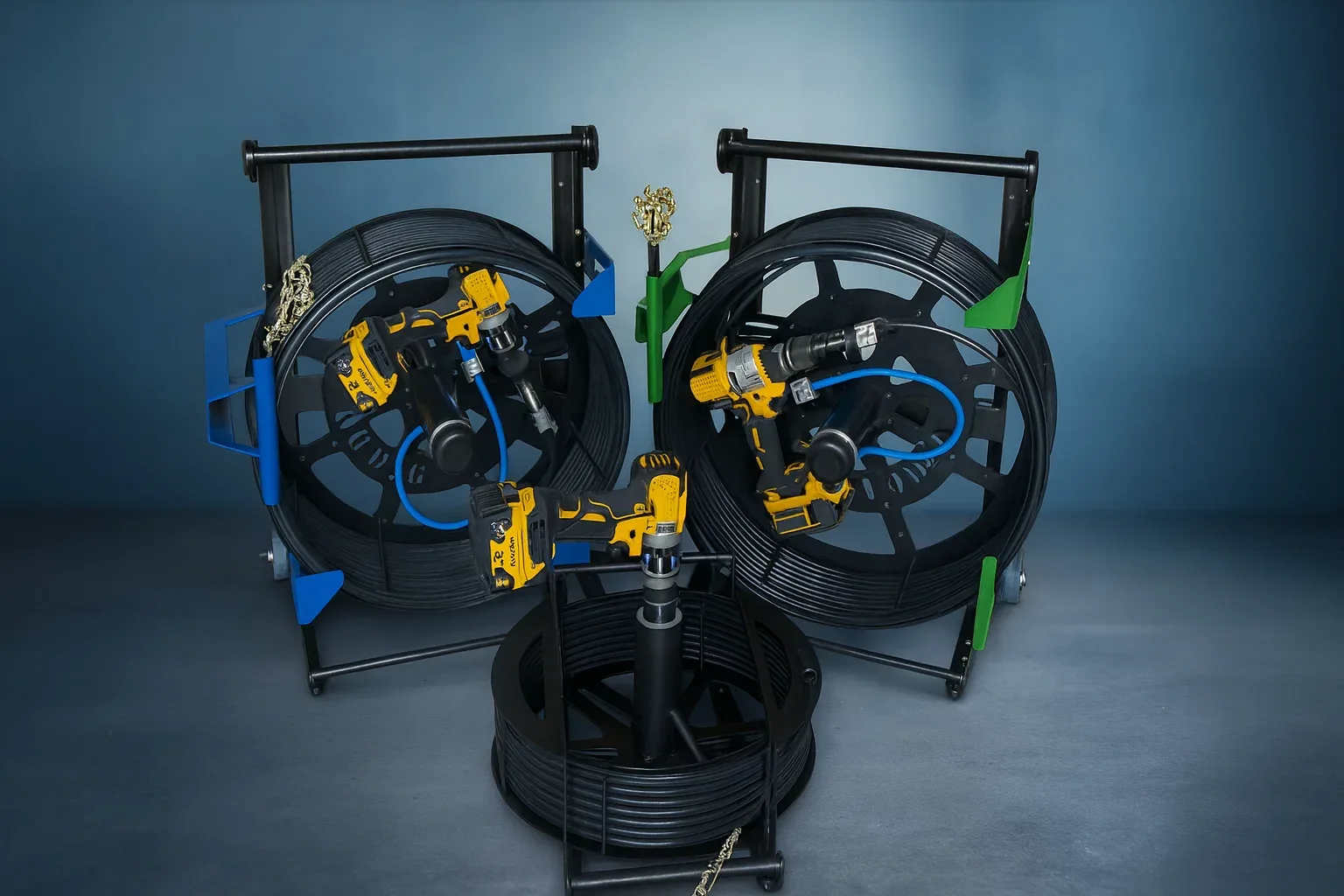
Once you know what is in the pipe, you select the tool. For the vast majority of epoxy lining projects, this means high-speed mechanical chain cleaning — NoDig V8, V1, or mini6, depending on pipe diameter and access conditions. Rotating chains abrade away scale, corrosion, and biofilm that are chemically bonded to the pipe wall. This is fundamentally different from what jetting achieves: jet cleaning removes loose deposits and obstructions, but it cannot mechanically prepare a surface for epoxy adhesion.
The number of passes and chain type are selected against the survey findings. The standard for completion is not "three passes done" — it is "camera confirms a consistent, dry substrate free of residual material." Anything less compromises adhesion, and a lining that fails adhesion does not fail gradually; it fails visibly and expensively.
Post-cleaning verification survey
The camera goes back in — this time not to diagnose, but to confirm. The verification survey documents pipe wall condition after cleaning and provides the formal basis for proceeding to the lining phase. If areas of residual deposit remain, cleaning continues. There are no shortcuts here: every section that is not correctly prepared will be a potential delamination point within a few years.
The verification survey is also a project record. Without it, there is no formal evidence that cleaning met the required standard — something that matters both for quality assurance and for any subsequent warranty claim.
Surface drying and conditioning
Epoxy will not bond to a wet substrate — this is fundamental polymer chemistry, not a precaution. Drying is not optional. Depending on site conditions, warm air blowing, compressed air, or a controlled drying period is used. In cold conditions or where condensation on chilled pipe walls is an issue, an appropriate primer may be required. The BSE epoxy system's technical data sheet and the survey findings together define the conditioning protocol.
Epoxy lining — brush coating or spray lining
The central phase of the project. BSE epoxy is applied using the ProLight or ProLight2 machine by one of two methods — brush coating or spray lining — selected on the basis of pipe diameter, substrate condition, and specified coating thickness.
Brush coating applies a continuous, uniform epoxy film by rotation of a brush head along the pipe wall. Suitable for most profiles, it is the standard method for smooth or lightly textured surfaces without significant irregularities.
Spray lining uses centrifugal application through the ProH2O spray head and a centraliser to deliver a thicker, more uniform layer. Centralisers are critical here: they maintain the spray head on the pipe centreline regardless of vertical displacement or profile variation, ensuring consistent coating thickness around the full circumference. This method is used for more challenging pipe conditions or where a greater coating thickness is specified.
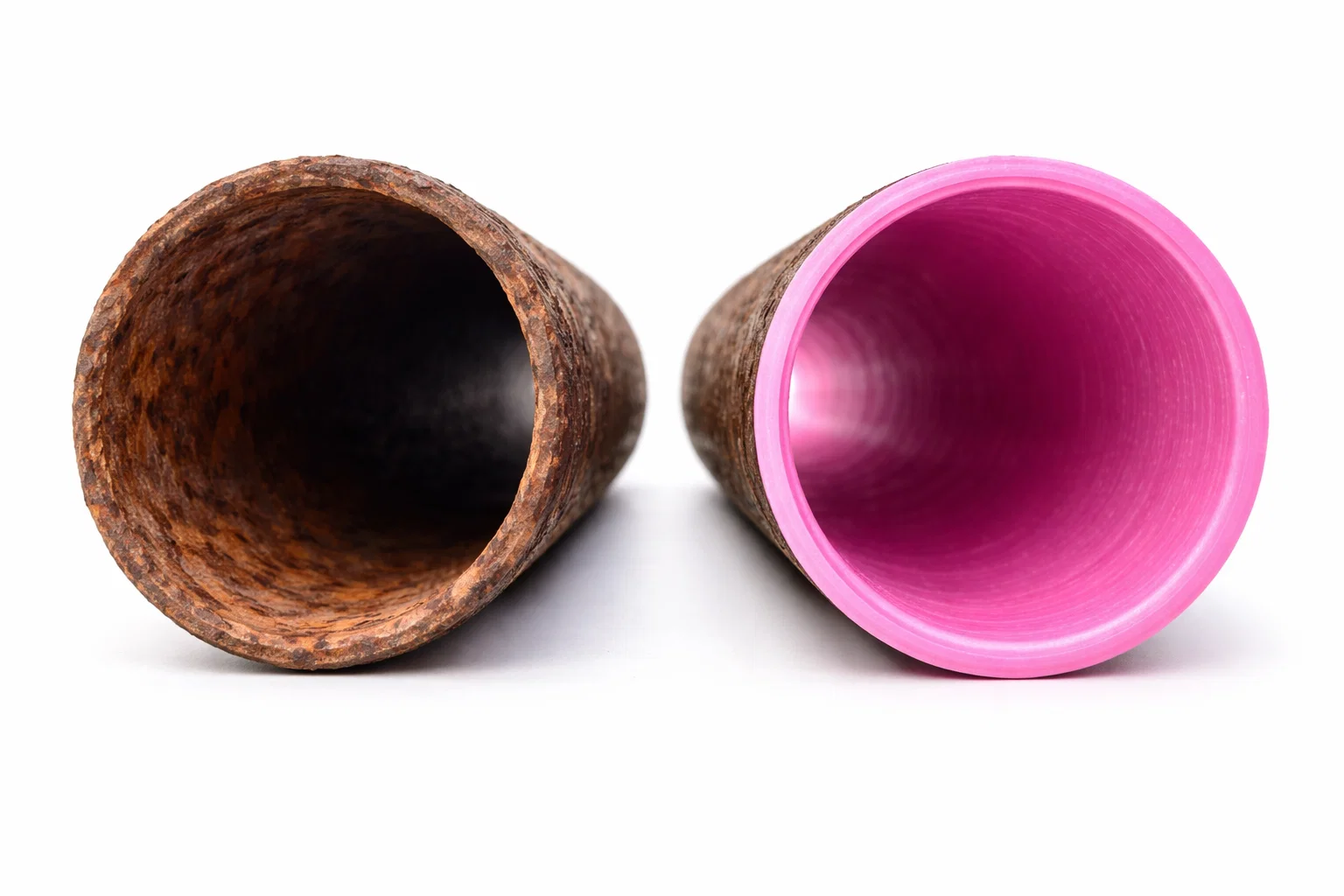
BSE is a two-component epoxy developed specifically for drainage and wastewater applications — resistant to the chemical aggression of sewer gases, to abrasion, and to thermal cycling. The 25–50 year service life figure is not a marketing claim; it is a material characteristic validated by accelerated ageing testing.
Completion survey and handover documentation
The project is not complete until the camera confirms it. The completion survey — carried out after full epoxy cure — documents lining appearance and coverage, confirms there are no areas where adhesion has failed, and records any lateral connections that required reinstatement. This footage becomes part of the formal handover pack to the client.
Complete project documentation comprises: pre-works CCTV survey with condition classification, cleaning protocol, verification survey, epoxy application record (mix ratios, temperature, coating thickness), and completion CCTV survey. For municipal clients, this is a contractual requirement. For private clients, it is the evidence that they received what they paid for.
Six phases — one guarantee
Each phase in this sequence has a purpose and cannot be substituted or skipped without consequences for the end result. This is not bureaucratic process for its own sake — it is the only foundation for the one thing that truly matters: a guarantee that the pipe performs as designed for as long as projected.
What this means for contractors looking to grow
There is a real distinction between a contractor who "clears blockages" and one who "rehabilitates infrastructure." The difference is not just equipment — it is what you offer the client. Complete project documentation, pipe durability on a par with new installation, and a reference list for utility frameworks — these are the elements that move a business out of the "reactive call-out" category and into "strategic drainage asset management partner."
Utilities and housing associations increasingly require exactly this. Rehabilitation tenders almost universally specify pre- and post-works CCTV surveys, cleaning verification, and application records. A contractor who cannot provide that documentation cannot access those contracts — regardless of the actual quality of their workmanship.
The defining moment isn't when the contract is signed. It's when the client opens the handover folder and says: "This is exactly what I needed."
NoDig equipment — V8, V1, and mini6 for cleaning; ProLight and ProLight2 for epoxy application; BSE epoxy system; centralisers for spray lining — is designed as a coherent ecosystem. The compatibility is deliberate: matching access configurations, consistent diameter ranges, a single material system. Contractors who run the full process with NoDig equipment are not switching between systems — they are speaking one language from first survey to final handover.
High-speed pipe cleaning — machines and applications Epoxy pipe lining — ProLight and the BSE system Read more: Why chain cleaning is not the same as jettingThe complete NoDig ecosystem — cleaning through rehabilitation
Cleaning machines, epoxy lining equipment, and the BSE material system — designed and manufactured in Osijek. Distributed across 15+ European countries.
Frequently asked questions
Duration depends on section length, pipe condition, and the method used. A typical project on a 50–100 metre section — from initial CCTV survey to handover documentation — is completed in one to two working days. Larger municipal projects with multiple sections are phased to minimise service disruption.
A correctly executed epoxy lining on a properly prepared substrate has a verified service life of 25–50 years, depending on pipe material and operating conditions. The critical prerequisite is mechanical chain cleaning — without it, the epoxy cannot achieve the adhesion required for long-term performance.
Brush coating suits smooth or lightly roughened profiles where a uniform thin film is sufficient. Spray lining by centrifugal application through a centraliser delivers a thicker, more consistent layer and is the method of choice for more demanding pipe conditions or where greater coating thickness is required. The survey findings determine which is appropriate.
Rehabilitation requires the section to be isolated and the substrate to be dry. For drainage systems, this means a temporary bypass or coordinated shutdown. The application itself is rapid and keeps out-of-service time to a minimum. For water mains, the process is coordinated with the network operator.
Depending on the severity — cracking, fracture, or deformation — epoxy relining may still be applicable following point repair of localised defects, or a CIPP (Cured-In-Place Pipe) solution may be more appropriate for serious structural failures. The pre-works CCTV survey with condition classification provides the basis for that decision.