Brush coating is a method of epoxy pipe rehabilitation in which a rotating brush head, attached to a flexible drive shaft, passes through the pipe and applies and works a two-component epoxy resin evenly onto the inner pipe wall. The result is a hard, continuous epoxy lining whose thickness is determined by pipe condition and project requirements — in practice, typically in the range of about 2–4 mm. When correctly applied, this lining prevents corrosion, seals minor cracks and can extend pipe service life by 25 years or more — without excavation.
Brush coating is designed to restore and protect the internal pipe surface. It is not intended to replace fully structural rehabilitation methods where the host pipe has lost its structural integrity.
Why does brush coating exist?
Brush coating was developed for situations where classic spray lining is not the optimal solution. In smaller diameters, complex geometries, sections with many bends, and short runs, a rotating brush head allows more precise control of application thickness, lower material consumption and a simpler process — while producing a high-quality protective lining.
How brush coating works — step by step
Brush coating is a contact method of epoxy application — and contact is precisely its key advantage: the brush physically touches the pipe wall, creating direct contact between the resin and the pipe surface and allowing the resin to fill the surface roughness of the substrate. This is what distinguishes it from spray lining, where the epoxy is atomised through air. The contact approach provides excellent control of coating application and consistent contact with the pipe wall, particularly in smaller diameters — but the prerequisite is the same as for any epoxy rehabilitation: a mechanically clean, dry pipe wall.
- System preparation: BSE epoxy components A and B are loaded into the ProLight press, which automatically dispenses them in the correct ratio. No manual mixing — no ratio error.
- Brush head insertion: the brush head is introduced into the pipe through the access chamber. The head diameter matches the pipe diameter.
- Epoxy application: the brush rotates and is drawn through the pipe — resin is pushed out of the head and pressed into the wall.
- Number of passes: two to three passes is standard. The operative determines the final number of passes based on measured thickness and substrate condition — each pass adds a layer of epoxy until the target lining thickness is reached.
- Curing: the epoxy polymerises on the pipe wall under site conditions. Cure rate depends on temperature and humidity.
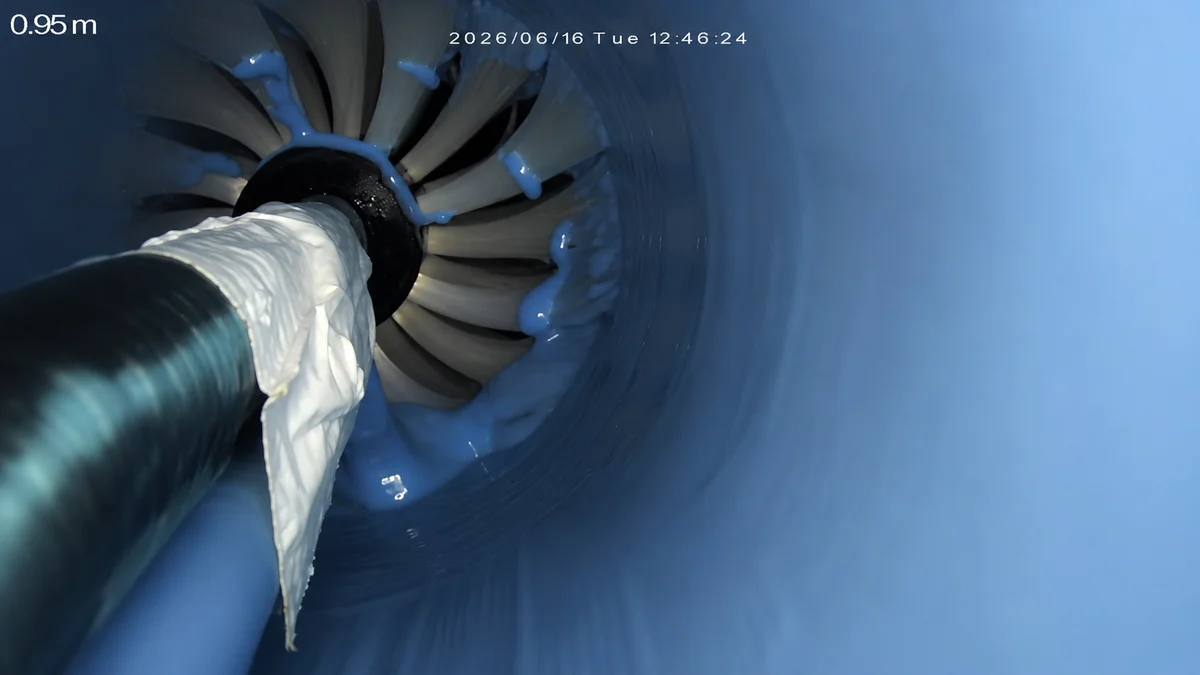
Brush coating vs spray lining — a difference that does not make one better than the other
Brush coating and spray lining are often positioned as competing methods, as though one is always the right choice. Both methods are capable of producing long-lasting rehabilitation when correctly designed and installed. The difference is in the physics of application and the diameter range where each performs best.
Brush Coating
- DN50–DN150, with some applications extending beyond this range
- Household installations and lateral connections
- Shorter sections, pipes with many bends
- High-viscosity epoxy systems
- Excellent thickness control
- Lower material consumption
Spray Lining
- From approximately DN100 up to very large diameters
- Longer sections, verticals, manholes, collectors
- Cement, concrete and larger sewer pipes
- Much faster application
- Rehabilitation of large diameters
- Corrosion protection and surface restoration
- Protective or project-specified lining systems where applicable
The boundary between the two methods is not strict. DN100–DN150 can be rehabilitated with either method. Brush coating is most commonly used from DN50 to DN150, although certain applications may extend beyond this range. An experienced contractor selects based on diameter, pipe condition and the rehabilitation requirements.
Is brush coating the right method?
Brush coating is generally recommended when:
- pipe diameters are between DN50 and DN150
- the host pipe remains structurally stable
- rehabilitation focuses on corrosion protection and surface restoration
- precise control of coating thickness is required
- pipe geometry includes multiple bends or junctions
- access is limited
For larger diameters or long straight sections, spray lining often becomes the more productive solution.
Why the component mixing ratio is not a matter of judgement
The BSE two-component epoxy resin is mixed to a precisely defined ratio of components A and B. That ratio is not an approximate guideline — it is a chemical requirement for full polymerisation. Too much or too little of component B means the lining will not reach its designed hardness and chemical resistance, regardless of how it looks immediately after application.
The ProLight has an integrated automatic press that dispenses both components simultaneously in the correct ratio on every pass. The operator does not manually measure or mix the resin. The machine automatically maintains the correct mixing ratio throughout the application process, regardless of pass speed or resin temperature. This eliminates one of the most common sources of latent failure in epoxy pipe rehabilitation.
What brush coating cannot replace
Brush coating is a method of applying epoxy — it cannot replace the mechanical cleaning that must come before it. Epoxy bonds to the pipe wall, not to deposits. Without high-speed chain cleaning prior to application, brush coating applies resin to strongly adhered deposits that will at some point separate from the wall — and take the lining with it.
High-speed pipe cleaning — preparing the wall for epoxy rehabilitation ProLight and BSE system — equipment for epoxy pipe rehabilitation Read more: Epoxy pipe relining — complete technical guideBrush coating is fast and reliable — but how long the lining lasts depends on pipe wall preparation, not on the application technique itself.
ProLight — designed for brush coating
Automatic press, precise dispensing, compact enough for everyday site use. Brush coating without compromises on mixing ratio.
Frequently asked questions
Brush coating is used on concrete, PVC, polypropylene, vitrified clay and steel pipes. The prerequisite is prior mechanical cleaning of the pipe wall — regardless of material.
It depends on the pipe diameter and wall condition. Two to three passes is standard, and the operative determines the final number of passes based on measured thickness and substrate condition.
No. Epoxy resin requires a dry surface — moisture prevents the lining from bonding correctly. A drying and conditioning protocol is a mandatory step between cleaning and brush coating application.
Brush coating uses rotating brushes to apply the material; spray lining uses a spray nozzle. Both are trenchless pipe rehabilitation methods, and the choice depends mainly on pipe diameter, pipe condition, and the required rehabilitation performance. Brush coating is most commonly used from DN50 to DN150, although certain applications may extend beyond this range; spray lining is used from DN100 upwards and is generally the more productive solution for larger diameters. The boundary is not strict — DN100–DN150 can be rehabilitated with either.