Spray lining and brush coating are two ways of doing the same thing — applying epoxy resin to the inside of a pipe through an existing access point, with no excavation. The difference is how the resin reaches the wall. In spray lining, centrifugal force does the work, and that single difference determines which diameters, geometries and run lengths the method suits — and which it does not.
What spray lining is, and why it is called SIPP
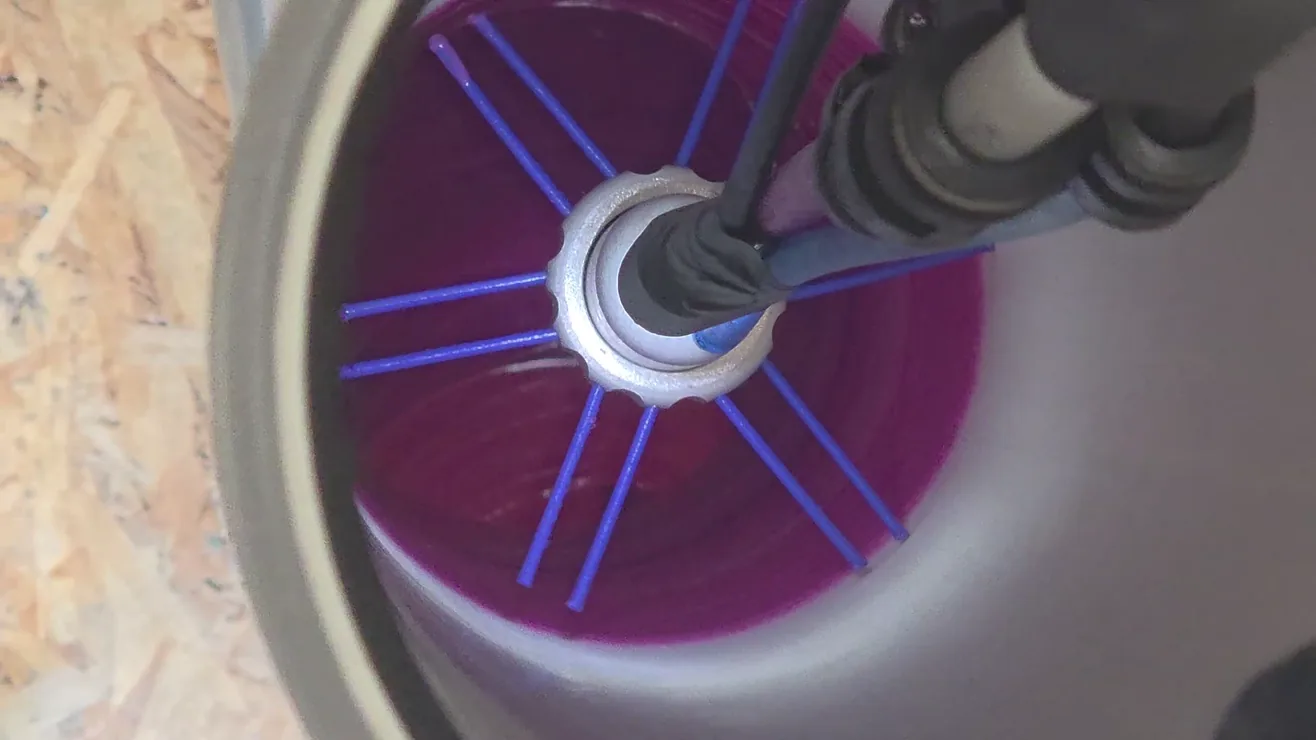
Spray lining is a trenchless method in which two-component epoxy resin is applied to the inside of a pipe by a rotating spray head. The head is drawn through the pipe at a constant speed while centrifugal force disperses the resin evenly around the full circumference. The method is also known as SIPP — Spray-in-Place Pipe — because a new wall is formed in place, inside the existing pipe.
How it works — step by step
- Access point and isolation of the section The section is taken out of service and reached through an existing opening — an inspection chamber, a rodding eye, or a disconnected branch. Nothing is dug up.
- Mechanical cleaning of the pipe wall High-speed chain cleaning removes scale, corrosion and biofilm. Without it the epoxy has nothing to bond to, whichever application method follows.
- CCTV verification of the wall The camera confirms that cleaning produced a uniform substrate and that there is no structural damage that would make lining the wrong answer.
- Drying and conditioning The wall must be dry. Standard epoxy resins will not bond to a damp surface, and moisture is not always visible to the eye.
- Drawing the rotating spray head The head is drawn at a constant speed while rotating, and centrifugal force distributes the resin around the full circumference. The camera runs directly behind the head, so the layer is monitored in real time.
- Cure and completion survey The section goes back into service only after full polymerisation. A final CCTV survey documents the continuity of the lining.
Why centrifugal application produces a smooth wall
In brush coating, a rotating brush mechanically spreads the resin across the wall. The result is a slightly textured surface and a high degree of control — multiple passes and local correction are both possible.
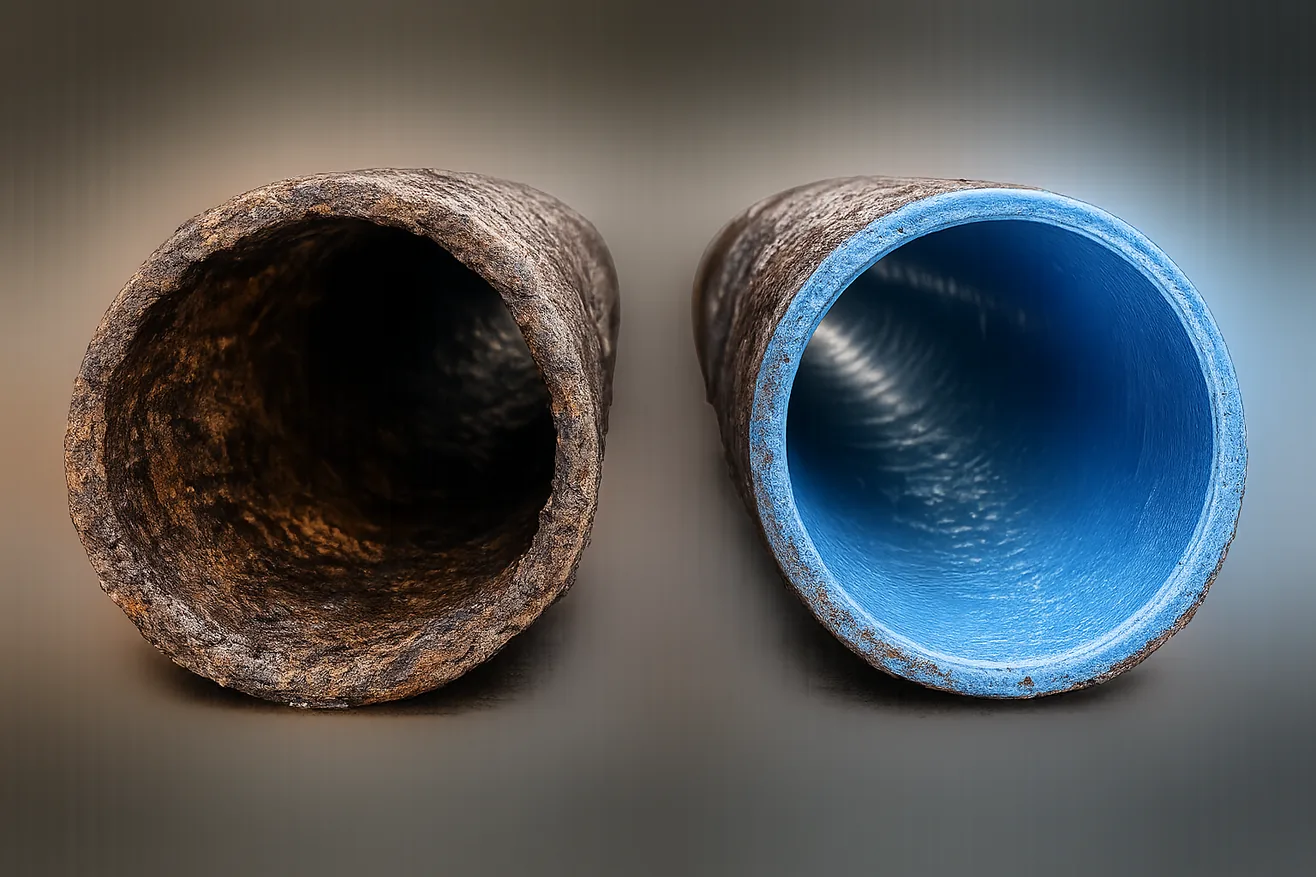
In spray lining, the resin is distributed by centrifugal force. The head rotates, the resin is thrown outwards and settles evenly around the whole circumference at once. The surface comes out smooth and the layer is consistent after a single pass.
A smooth wall is not cosmetic. Lower roughness means less flow resistance, so the rehabilitated pipe keeps its hydraulic capacity instead of trading it away for lining thickness.
Where spray lining has the advantage
- Straight runs of consistent diameter. The geometry in which centrifugal application gives the most uniform result.
- Larger diameters, DN100–DN300. The range in which a spray head outperforms a brush.
- Long runs. Application is faster, which suits projects covering significant length.
- A smooth finished surface. It matters wherever flow capacity is a design concern.
- An even, thin layer. One pass instead of several.
Where it stops being the right choice
- Bends, junctions and irregular geometry. Brush coating is more precise here — the brush physically follows the wall, whereas a spray head relies on a regular circumference.
- Smaller diameters. Below DN100 the advantage moves to the brush; NoDig equipment starts at DN32, but not with the same method across the whole range.
- Local correction. Brush coating allows an extra pass at one specific spot. Spray gives an even layer, but targeted rework is harder.
- Structural damage. If the pipe has collapsed or a section is missing, no epoxy lining solves that — it is a job for a different rehabilitation method.
Spray lining is not “better” than brush coating
The two methods are complementary rather than competing. The choice follows the geometry and diameter of the pipe, not the contractor's habit, and it is made on the evidence of a CCTV survey rather than on which head happens to be fitted. That is why ProLight and ProLight2 support both.
Layer thickness and pull speed are not a matter of judgement
Lining thickness is set by three parameters that have to hold together: the pull speed of the head, the rotation speed, and material flow. Change one without the other two and the layer becomes uneven — too thin in one place, too thick in another.
That is why the camera runs directly behind the spray head. Application is not estimated by feel; it is watched as it happens, and a deviation is corrected on the spot rather than discovered at the final survey once the resin has set.
The same applies to the mixing ratio of the two epoxy components — that is a chemically fixed relationship, not a setting to be adjusted as convenient.
Equipment and material
ProLight covers DN32–DN125 and ProLight2 covers DN40–DN150. Both machines support brush coating and spray lining, so the method is chosen to suit the pipe rather than whatever is on the van.
For larger diameters and longer runs there is The Pipe Boy, DN50–DN300.
BSE stands for Brush Spray Epoxy — a two-component epoxy developed for both application methods, so the material does not change when the head does.
Epoxy pipe rehabilitation — ProLight and the BSE system Brush coating — how it works and when to use it High-speed pipe cleaning — preparing the pipe wall Read next: Five mistakes that ruin an epoxy pipe lining jobThe method is not chosen by habit — it is chosen by the geometry of the pipe.
Equipment that supports both methods
ProLight, ProLight2 and The Pipe Boy cover DN32 to DN300, and BSE epoxy is formulated for both the brush and the spray head — same material, same documentation, same standard of work.
Frequently asked questions
The application principle. Brush coating uses a rotating brush to spread epoxy mechanically across the wall; spray lining uses centrifugal force to disperse it evenly around the full circumference. Everything else follows from that: spray gives a smooth surface and an even layer in one pass on straight runs, while the brush gives more control on bends and irregular geometry.
The optimal range is DN100–DN300. Below that the advantage moves to brush coating, which is optimal across DN32–DN150. NoDig equipment covers the full DN32 to DN300 range through ProLight, ProLight2 and The Pipe Boy.
It is technically possible, but on irregular geometry brush coating gives better control of the layer because the brush physically follows the wall. The decision is made on the CCTV survey — if a section has several bends or lateral connections, the brush is usually the safer choice.
The design life of a properly executed epoxy lining is 25 to 50 years. What decides it is not the application method but the preparation of the wall — without thorough mechanical cleaning and a dry substrate, no method reaches its designed adhesion.